
Kane County Tax Record Fields
Kane County splits its property tax records between two offices. The Assessor describes each parcel and sets its taxable value. The Treasurer maintains the bills, the payment routes, and any delinquency information. So a value and a bill answer two different questions. The county itself offers a warning. EagleWeb can pair a current owner with a prior-year value. It can also show taxes tied to an earlier owner.
| Field | What It Shows | Where |
|---|---|---|
| Taxable value | Current tax-year taxable figure; may lag other data | Kane Assessor / EagleWeb |
| Owner and parcel | Owner, situs, mailing, account, and parcel identifiers | Kane Assessor |
| Classification | Primary, nonprimary, agricultural, commercial, exempt, and other categories | Kane Assessor |
| Residential exemption | 45% reduction for qualifying property; application is required | Kane Assessor |
| Tax bill and payment | Tax account, payment path, and available status | Kane Treasurer / Billtrax |
| Delinquent list | County-posted delinquent property tax listing | Property Tax Services / Treasurer |
No published sample bill lays out every field or taxing-district breakdown, so treat the public card as a starting point rather than a template. The Assessor answers roll questions; the Treasurer answers account questions. And where a deed lists sale consideration, that figure is a different number from assessed or taxable value.
Kane's January Assessment Date
Kane County sets its assessment roll by the legal owner of record on January 1. A deed recorded later in the year normally shows up on the assessment record the following year. So the Assessor's owner entry and the newest deed held by the Recorder can name different parties. Neither one is a mistake. Keep that timing in mind whenever you run a Kane County property search.
EagleWeb adds one more wrinkle. It can display current ownership or acreage beside last year's taxable values. Taxes may still be tied to a prior owner. Always note which tax year you are viewing. Before a sale, compare the recorded deed and its legal description against the assessment account for the parcel. A tax bill alone is never proof of who owns the parcel.
Assessor Fields Used for Tax Search
The Kane Account Search lets you find a parcel by account, owner, address, legal description, class, value, or acreage before opening the tax record. These are search filters, not a published sample bill. Adding criteria narrows the results. If a known parcel vanishes, remove a filter.
| Search Field | Input | Tax Lookup Use |
|---|---|---|
| Account Number | Text | Carry the account to Treasurer Web |
| Parcel Number | Text | Match the mapped or recorded parcel |
| Owner Name | Normal / Advanced | Find an account when the address is unknown |
| Situs street fields | House number, street, direction, suffix, unit | Locate the tax parcel by its site address |
| Subdivision and lot | Subdivision, lot, block, tract, unit | Search a platted parcel |
| Class / value / acres | Multi-select and ranges | Limit results by tax classification or size |
The 45% primary-residential exemption requires an application. The Assessor publishes no complete list of other local exemptions, no mill-rate table, and no exact online bill fields. Ask the Assessor about eligibility and the Treasurer about the bill rather than assuming a category from another Utah county.
Finding a Kane County Tax Bill
To pull Kane County property tax records, first find the account in EagleWeb. Do this when the bill number is unknown. Then follow the Treasurer's Make a Payment path. Treasurer Web serves as the tax-search entry, while Billtrax handles the payment itself. The County Property Tax Services page gathers the tax records, the delinquent list, appeals, and Property Watch. It puts them all in one spot. Check the name and year on the bill against the assessment date. Do this before acting on any transfer or payment question.
- Search EagleWeb Account Search by address, owner, account, or parcel number.
- Copy the account number and identify the tax year shown by the Treasurer.
- Use Treasurer Web or Billtrax for the bill and payment route.
- Check Assessor classification and any approved primary-residential exemption separately.
- For a delinquency question, compare the current Treasurer account with any later Recorder notice or deed.
- Assessed value
- The Assessor's value entry for a parcel; it is not a sale price.
- Taxable value
- The figure used in the current tax calculation, subject to the applicable classification and relief.
- Primary-residential exemption
- A 45% taxable-value reduction for qualifying property; an application is required.
- Tax lien
- A claim recorded or imposed for unpaid tax; check the Treasurer and Recorder for their respective records.
- Delinquency
- An unpaid tax status; it does not by itself prove a completed sale.
Kane Treasurer Payment Choices
The Kane County Treasurer accepts payment by mail, telephone, in person, or online. Mail goes to Kane County Treasurer, 76 N Main St, Kanab, UT 84741. The telephone service line is 833-804-6596, and the office number is 435-644-5659. Hours run Monday through Thursday, 8 a.m. to 5 p.m. Friday hours are 8 a.m. to 4 p.m. Billtrax adds a processor fee. Cards cost 2.50% with a $1.50 minimum. ACH/eCheck costs $0.75. These are payment-handling charges, not tax rates and not Recorder copy fees. The county's official page displays the Treasurer's search and payment guidance. That separation helps keep a tax account lookup apart from the Assessor's value search. Kane County's Treasurer page lists payment methods and processing fees.
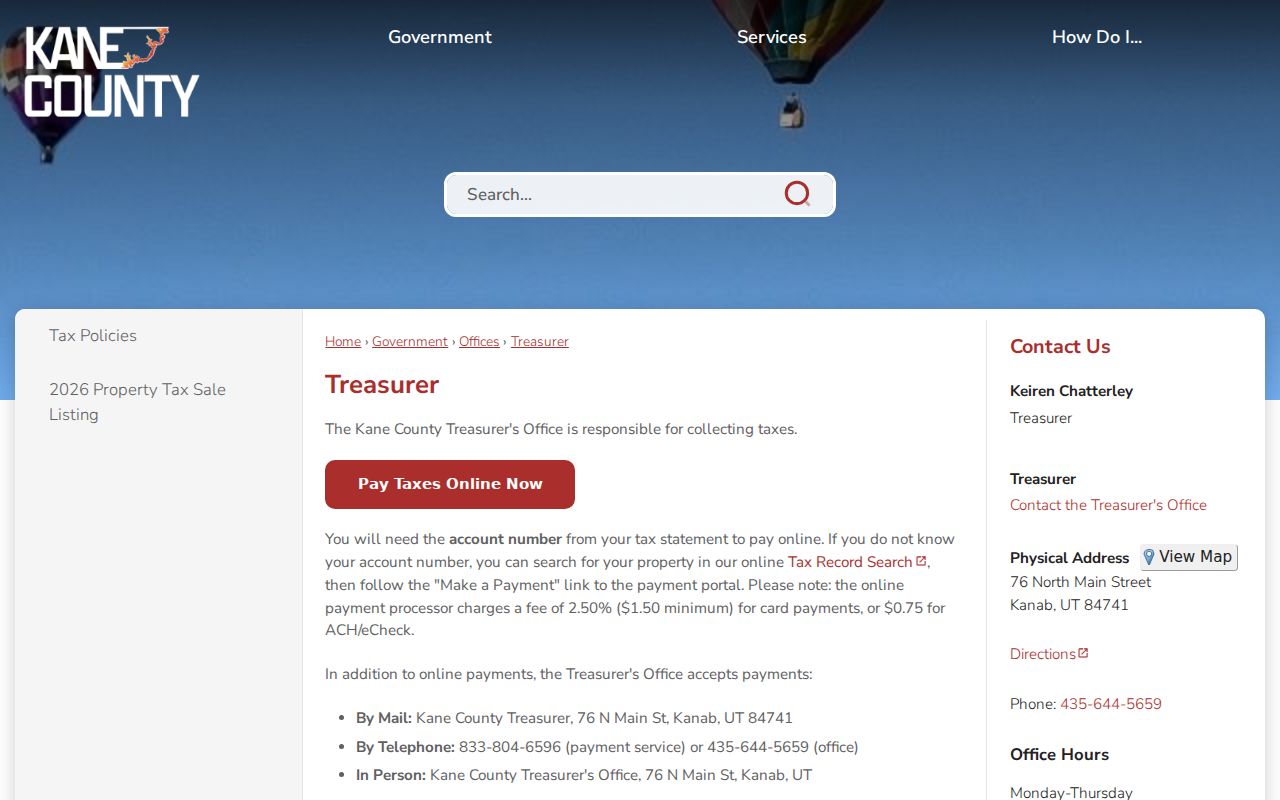
Before paying or comparing amounts, confirm the account number and tax year on the official Treasurer screen. Details matter here. Note: The Treasurer's fee schedule covers payment processing only and should not be confused with the assessed value or the amount due.
Delinquent Kane County Tax Records
Kane County Property Tax Services posts a Delinquent Property Tax Listing. The county does not currently publish a populated copy online. A delinquent Kane County property records search should start with the Treasurer's account view. That account shows the tax year and its status. Then turn to the Recorder's deed index. Recorded notices can include a notice of default, a trustee sale notice, or a sheriff sale notice. They can also include a preliminary tax-sale deed, an amended tax deed, or a release. An index entry pointing to one of these documents hints that a later event occurred. It is not proof that title actually transferred.
Kane County publishes no sheriff-sale calendar. There is no stated tax-sale publication frequency or published redemption timeline. The delinquent list itself may change contents from year to year. Never state a sale date or deadline from an old notice alone. Confirm the status with the Treasurer and the Recorder. Where the record shows a proceeding, read the underlying court or legal notice too.
The portal does not always expose a record. Send a written GRAMA request to the office that keeps it. Identify yourself, give a response address, and describe the tax record or notice precisely. Include the parcel or account number and the relevant year. Utah's ordinary response period runs 10 business days. A request may qualify for the expedited public-interest period. It can draw a response within five business days. A custodian may charge reasonable actual costs for filling the request. If access is denied, request the written decision and appeal through the agency's chief administrative officer.
A tax delinquency entry is easy to overread. A late or unpaid amount can trigger notices and later proceedings. By itself it shows no completed tax sale. It also shows no change in the owner of record. Look for a later recorded tax deed and compare its legal description with the account. If no conveyance appears, ask the Treasurer whether the listed status still stands.
Appealing a Kane County Assessment
A Kane County owner can appeal to the Board of Equalization. This happens when the owner disputes a market value. The county's instructions print the filing deadline on the current notice. Filing works by email, mail, or the online valuation appeal portal. No single universal calendar date exists. Rely on the deadline printed on your assessment notice rather than a date carried over from another year.
Good evidence ties the requested value to the parcel and the assessment date. The Board of Equalization page lists examples. Comparable sales, a recent appraisal, photographs, and repair estimates all qualify. Each one counts as support for the claimed market value. Include the account or parcel number and state plainly which figure is disputed. The county's appeal-instruction page spells out these market-value steps and evidence examples. Review Kane County's Board of Equalization appeal steps and evidence guidance.
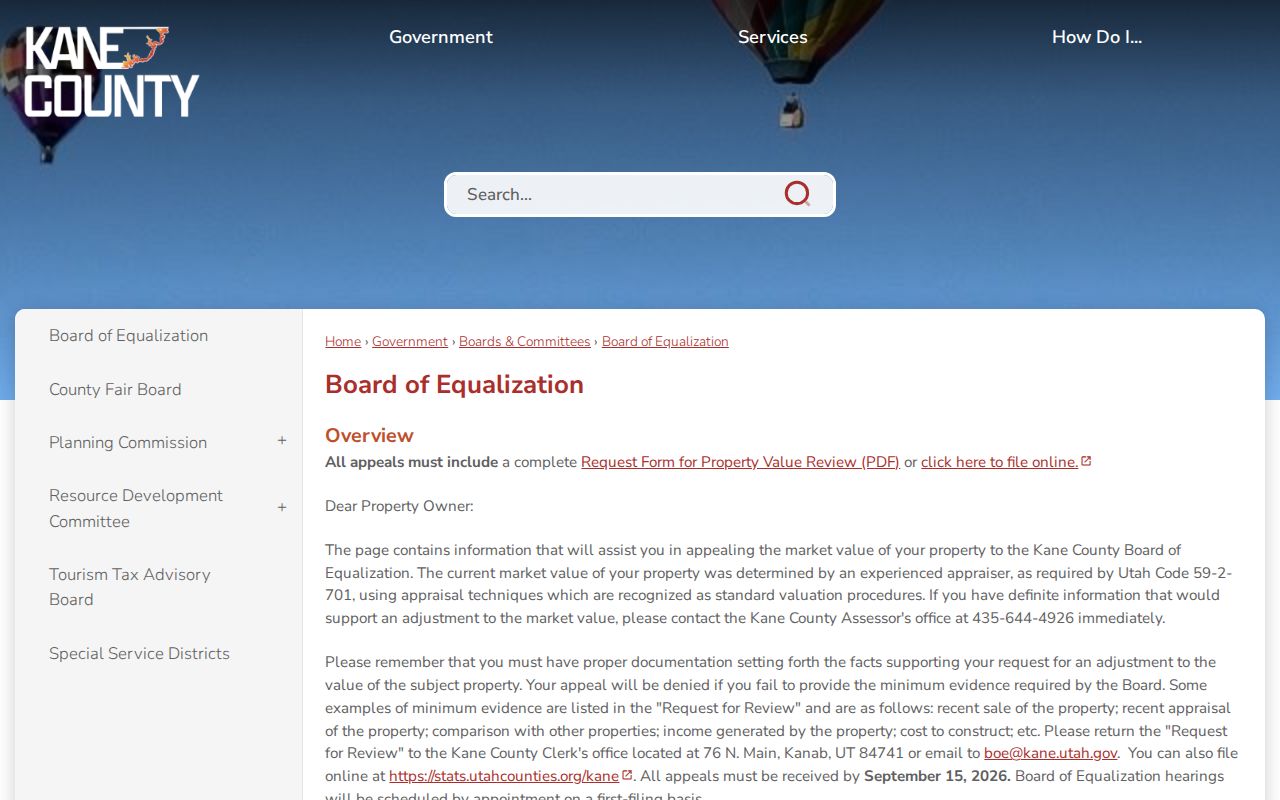
Follow the current notice and the Board's instructions when filing. An appeal guide is guidance only, never a promise of outcome.
Appeal window. File by the date stated on the current assessment notice and use the County's online, email, or mail route. The deadline can change by cycle.
Tax Values After a Kane Sale
A recorded sale and a tax value measure different things. The deed records a conveyance. It may show sale consideration if the filed instrument or its image exposes it. The Assessor sets the taxable value for a given tax year. The Treasurer's tax bill reflects that account's taxes. It also shows payments on the account. A prior-year tax amount appearing beside a new owner is possible. Kane County gives its own timing warning. Kane County property records make sense when each number is labeled for what it is. The label matters: assessed, taxable, billed, paid, delinquent, or recorded consideration. Do not treat the taxable value as a current market appraisal. The Assessor's entry can support an appeal. But the Board of Equalization runs that process under its own deadline and evidence rules.