
The Kane Owner-of-Record Card
The county's public EagleWeb parcel card shows owner information, situs and mailing addresses, acreage or ownership details, and the taxable value for the current tax year. Two cautions come with it. Not every building on a parcel will display. Ownership data can run newer than the values or taxes shown beside it. The inventory below separates the categories EagleWeb confirms. Only a live account view will settle the remaining details.
| Owner / Ownership | Owner information attached to the account |
|---|---|
| Mailing Address | Notice address; may differ from parcel location |
| Situs Address | Address field for the parcel's location |
| Account / Parcel | Account Number and Parcel Number are separate identifiers |
| Acreage | Ownership or acreage information is confirmed in the public description |
| Taxable Value | Current tax-year figure; can reflect an earlier roll date |
| Deed reference / last sale | Exact parcel-card fields were not confirmed |
The owner of record is simply the party named in the county account. The situs address locates the land itself. The mailing address is where the county sends notices, and the Recorder treats the address written on the deed as the notice source until the owner files a change. That mailing address can be a lawful contact path for a property matter. It says nothing about who is physically at the parcel, though. So treat it as contact information rather than proof of occupancy.
Kane's January 1 Roll Date
Kane County sets its assessment roll by a legal owner of record. That date is January 1 of each year. A deed recorded after that date will not show up in assessment records. The change waits for the next roll. So a current owner search can return a name that was right on the roll date. It may still miss a deed filed weeks later.
EagleWeb, the county's assessment portal, carries its own timing caution. Ownership and acreage on the screen may be current. Taxable values and taxes may still reflect last year and a prior owner. Always compare the year attached to the value with the date on the deed. An old tax value proves nothing about who holds title today.
Confirming a Kane County Transfer
Confirming the current owner takes two records. Compare the Assessor entry with the newest deed describing the same parcel. In that deed, the grantee receives the interest and the grantor conveys it. The index locates the instrument; the Recorder's office supplies document images under its access rules. Never search a name alone. A name without its legal description can match a different parcel or an earlier transfer entirely.
- Open the Kane Assessor Account Search and note the owner name, account, parcel, situs, and mailing address.
- Search the Recorder index for the latest deed under the owner or prior grantor name.
- Compare parties, date, and legal description with the same parcel account.
- Check for later releases, corrections, or successor deeds if the transfer is not clear.
- Ask the Recorder for an official copy when the index result is not enough.
- Owner of record
- The name attached to the county assessment account.
- Grantee
- The party who receives an interest in a recorded deed.
- Vesting
- The way a deed describes how an interest is held; the live instrument controls.
- Situs address
- The location address associated with the parcel.
- Mailing address
- The notice destination recorded for correspondence.
Kane Mailing and Site Addresses
Mailing and situs fields diverge for ordinary reasons. An owner may receive tax notices at a different address. Or the property may run under a separate business address. Kane's Recorder keeps the deed address as the mailing source until the owner files a change. Preserve both lines when reviewing a current owner record. A mismatch is a reason to check the deed or ask the office, not evidence that a transfer never happened.
Street origins also differ across the county. Kanab references Center Street/US 89 and Main Street. Orderville uses State Street/US 89 and Center Street. Big Water uses US 89 and Arron Burr Drive. Near those towns, keep the community name attached to the situs query so a local address is not measured from the wrong origin.
Entity Names on Kane Property
A parcel can sit in the name of an LLC, corporation, trustee, trust, estate, heir, or personal representative. The Assessor may display the account owner. The deed spells out the capacity and the transfer. Utah's Division of Corporations and Commercial Code offers public entity status, registered-agent, and filing details. That state record helps interpret a name. It does not prove the entity owns any particular parcel.
For trusts and estates, the Recorder index includes deed categories such as Deed to Revocable Trust, Personal Representative Deed, Heir's Deed, and Deed of Distribution. A probate order or authority document may explain why a representative acted. The recorded instrument is what updates the land records. Match the entity file to the right Kane account through the parcel number and legal description.
Monitoring a Kane Owner Record
Kane Property Watch is free. After an owner signs up with an account number and a valid email, it sends deed, lien, or transfer alerts. An alert flags a new filing but certifies nothing. So confirm it in the Recorder index and request the underlying record through the office. The county's signup page describes the enrollment step and the account-number requirement. It matters once the right parcel account is identified, rather than as an open name search. Kane County explains how Property Watch enrollment and alerts work.
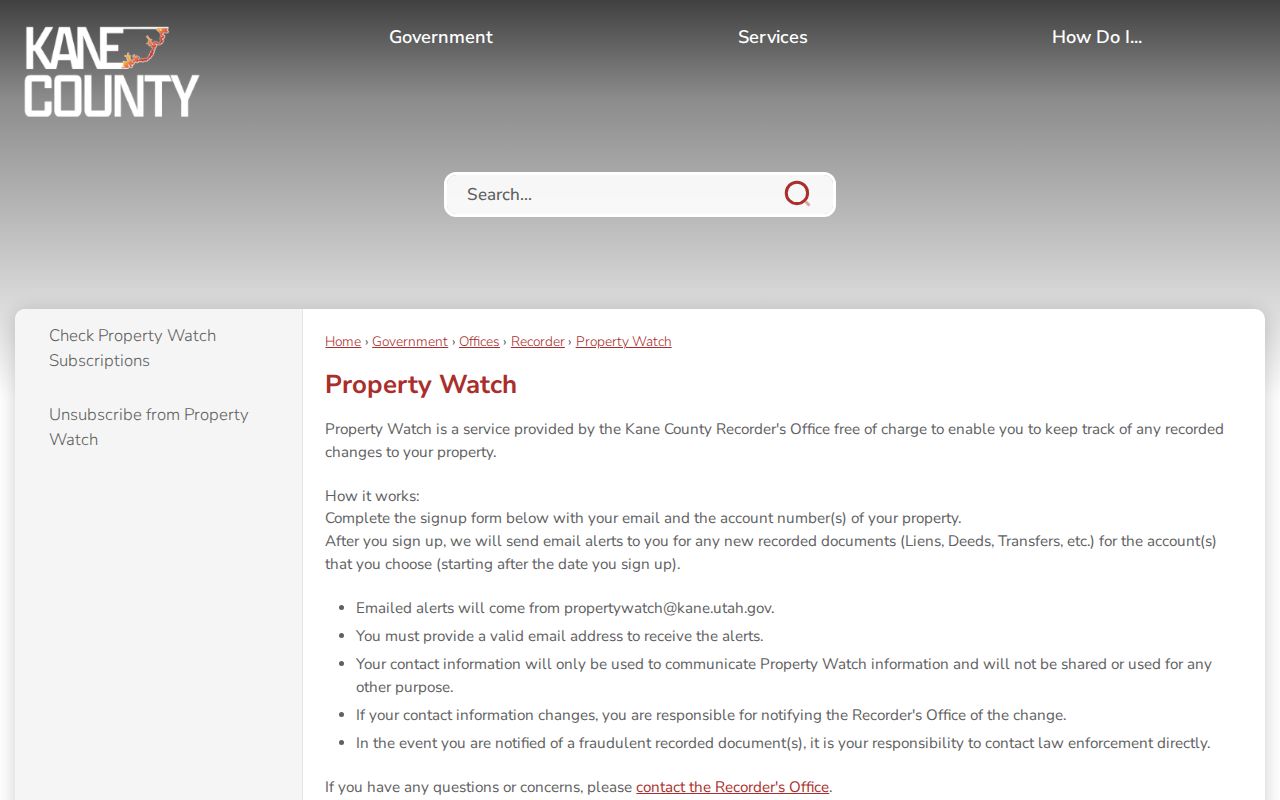
Treat each alert as a prompt to verify the deed or lien with the Recorder. It is not a title search.
Getting a Kane Owner Record
The Assessor runs a free public retrieval portal built on EagleWeb. It is the quickest route to a current account. Call the office if a result seems unclear. Staff can walk you through the owner, address, acreage, and value fields. Deed images are a different matter. The portal's own description offers no public deed images. That part of a Kane County property records search still runs through the Recorder at 76 North Main Street in Kanab, or by phone at 435-644-2360.
A written Utah GRAMA request works when you need a specific record from a governmental office. Identify the property by parcel or account number. Name the record type and keep the date range tight. The custodian may charge reasonable actual costs for the copy. The point is to obtain a record from its keeper. Do not guess at details the public account never exposes.
A recent transfer takes a bit more care. Give the Recorder both party names if you have them. Include the approximate recording period and the parcel's full legal description. Deed indexes hold similar names, and one account can carry more than one instrument. An estate or trust may also act through a representative. Ask for the image or a certified copy rather than trusting a secondary summary. Keep the recording number with its date so any later inquiry lands on the same filing.
One quirk trips people up. When an account shows a former owner, compare the newest recorded deed's date against January 1. The Assessor's tax roll carries an annual owner date. A deed filed mid-year can post to the roll late. That lag is record timing, nothing more. It is not by itself proof that the Recorder failed to index the transfer.
Contact and Privacy Limits
A Kane County owner lookup shows the recorded or assessed party. It also shows a public mailing field where one exists. Utah's Safe at Home program shields enrolled participants' actual addresses. It withholds them from government disclosure except as authorized. GRAMA draws its own lines, sorting records into public, private, controlled, and protected classes. Take any redaction or classification question to the custodian. Reconstructing a protected address is not the way.
Lawful use. Use owner information for a property matter or due diligence. Do not use names or addresses to stalk, harass, impersonate, or harm anyone. A public record is not permission to target a person.
When the current tax roll and the latest deed disagree, record both sources with their dates. If the answer matters to a transaction, a title professional can review interests beyond the assessment account.