
Kane County Deed Types and Transfers
The Recorder indexes many kinds of conveyance in Kane County. A grant deed, quitclaim, or joint-tenancy deed moves an interest. Gift deeds, trustee's deeds, and personal representative's deeds appear as well. So do heir's deeds, deeds of distribution, tax deeds, and deeds in lieu of foreclosure. The instrument label tells you what was filed. The legal description and party names tie the deed to the right parcel.
| Deed Type | What It Does | Common Use |
|---|---|---|
| Grant deed | Records a conveyance from grantor to grantee | Sale or other transfer |
| Quitclaim deed | Conveys the interest the grantor has, if any | Family or title cleanup |
| Joint tenancy / gift deed | Records the named form of conveyance | Co-owner or gift transfer |
| Heir / personal representative deed | Transfers estate property under authority stated in the filing | Succession or distribution |
| Trustee / tax deed | Records a transfer by trustee or through tax process | Trust, foreclosure, or tax proceedings |
A mortgage, trust deed, lien, or easement is not a deed that conveys ownership. It encumbers or affects the land instead. Kane County's deed index lists these beside actual transfers. Read the document type and legal description before drawing any conclusion about who holds title. A deed evidences a transfer, not clear title.
Kane Recorder Document Search
EagleWeb Document Search covers every recorded instrument. Search everything at once or narrow by type. The Kane County list includes deeds, mortgages, releases, easements, plats, maps, liens, judgments, and lis pendens. Notices of default and trustee sale appear as well. Annexation records, probate and heir documents, and water records appear too. Some labels are legacy or duplicated, so search broadly when the filing category is uncertain.
| Search Field | What It Does | Research Note |
|---|---|---|
| All Document Types | Searches across the displayed categories | Checked by default in the inspected form |
| Document Type | Narrows to one or more filing labels | Multi-select with legacy duplicates |
| Party name | Searches grantor or grantee names | Try name variants and entity forms |
| Recording/document number | Matches a known reference | Exact format not captured |
| Book/page and date range | Narrows an older or known filing | Rendered labels were not fully captured |
| Search / Reset | Runs or clears the query | Open a result for full index details |
The Recorder's help text describes entering search criteria, submitting the query, and opening a result for full index information. Open any deed result to see what it displays. Document dates, consideration amounts, image links, and parcel cross-references vary by entry. Confirm details with the office before relying on them.
Using Kane's Grantor-Grantee Index
The grantor conveys the interest. The grantee receives it. A Kane County chain-of-title search follows both sides of every transfer. Start from a known owner or deed reference. Identify that party as grantee on the acquisition, then search the same name as grantor to catch the later conveyance out. Reverse the process to find the prior acquisition. The online index publishes no start year, so a parcel's earliest history may sit in older deed books or in-office archive indexes.
- Find the most recent relevant deed by the current owner's name or known parcel clue.
- Record the grantor, grantee, instrument reference, date, and legal description shown in the index.
- Search the prior grantor as a grantee to locate the earlier acquisition, then repeat.
- Compare legal descriptions and marginal references so a similarly named parcel is not mistaken for the same land.
- When the index stops, ask the Recorder about in-office indexes and deed books, then check Archives finding aids.
- Grantor
- The person or entity that conveys an interest in the instrument.
- Grantee
- The person or entity named as recipient of that interest.
- Chain of title
- The sequence of recorded transfers tied to the same land.
- Book and page
- A volume-and-page reference used in older indexes or records.
- Instrument number
- A filing reference; the exact Kane format was not captured.
Kane Deed Copy Fees and Access
Copies work differently from searches. The online Document Search is free, yet the County's public description says images of recorded documents require a visit to the Recorder's Office. Contact options include in person, phone, mail, or the office's website contact form. The office sits at 76 North Main Street, Kanab, UT 84741; the phone number is 435-644-2360, answered Monday through Friday, 8 a.m. to 5 p.m. Recording stops at 4:30 p.m. Ask whether an emailed or mailed copy is available for the instrument you need.
The fee schedule in effect after May 6, 2026 sets $0.50 per printed page, $2 per emailed deed or map page, and $5 plus $0.50 per page for a certified copy. Recording a new instrument costs $45, while plats run $55 per sheet plus $2 per lot. Those filing charges are separate from copy prices. The Recorder does not supply deed forms and recommends a title company for a full title search.
A certified copy confirms only that the Recorder issued it. It does not certify that a title is free of liens or that a deed has no legal defect. Narrow your request by providing the parcel number, party names, approximate filing date, and legal description when known.
Kane's Older Deed Books
The earliest online index year is not stated. Older volumes may sit beyond it. Utah Archives series descriptions cover deed records, grantor and grantee indexes, mortgage records, plat maps, and subdivision indexes. Federal tax liens, mining, UCC, and water records appear in the catalog as well. A series description proves a record group exists. It does not prove every volume is digitized or searchable online.
Start with the current parcel. Capture its legal description and the last known instrument. Ask the Recorder which in-office index, deed book, microfilm, or tract index applies to the era you need. Then turn to the Archives catalog or name indexes to locate the right series, box, or image group. The Utah State Archives research portal offers catalog, name-index, and digital-collection searches. Not every series is digitized.
A territorial boundary change in 1882 moved a large western area tied to Kane into Garfield County. An older transfer may be filed there. Check the deed date and historical jurisdiction first. An empty Kane County deed search is not proof that a record is missing.
Requesting a Kane County Deed
Find the deed you need in the free index first. Then ask the Recorder for an official copy. Give the office the party names, document type, and approximate recording date. Add the account or parcel number and legal description if you have them. Staff can tell you whether that reference is enough. They can pull a plain, emailed, or certified copy. A mail or phone request works well when a courthouse trip is impractical. Visiting in person lets you inspect the office index and image access yourself.
Recorded, not guaranteed. A Kane County deed index shows instruments filed in the Recorder's system. It is not a title opinion, and the Recorder warns that some liens or judgments may not be found there. A title company can perform the broader title search.
Estate and Heir Deeds in Kane
Estate transfers show up in the Kane County index under several instrument names. You might see a Deed of Distribution, a Personal Representative Deed, an Heir's Deed, or a Probate Judge's Deed. Each label marks a different step in the transfer. The recorded deed gives notice in the land records. The probate file shows the court authority behind it.
Utah State Archives and FamilySearch describe a Kane probate index covering 1864-1896, plus probate minutes book B from 1878-1896. Not every probate or deed through 2001 is digitized. For later files, check Utah Courts Xchange. Ask the Sixth District Court clerk whether the case is still with the court or has moved to Archives. Vital certificates are supporting records with their own eligibility rules. They never substitute for the deed or probate order. Utah's Office of Vital Records and Statistics provides its official certificate-ordering route. A death record can help establish a fact in an estate inquiry. The Recorder's estate deed or court order remains the land-transfer record.
Kane Liens, Releases, and Plats
The deed index in Kane County holds far more than deeds. Trust deeds, mortgages, assignments, and satisfactions all sit in the same index. So do partial reconveyances, releases, notices of lien, federal tax liens, judgments, and lis pendens. Easements, leases, and plat or annexation instruments sit there too. Search the owner of record's name, and add the parcel or legal description where available. Match any later release to the original filing by parties and recording reference. A similar name alone is not enough.
For subdivision history, dig into plats and subdivision maps. Road dedications, boundary adjustments, annexation resolutions, and certificates of annexation belong in the same search. The County Land Use Authority posts forms for plat amendments and vacations. It also covers minor subdivisions and boundary actions. A plat establishes the recorded lot layout. A GIS polygon is only a reference layer. For exact placement, review the filed survey or consult a licensed surveyor.
Note: A release clears only the interest it describes. Compare the legal description and recording reference against the original claim.
Court Cases Behind Kane Deeds
A lis pendens, quiet-title action, partition, foreclosure, probate dispute, or judgment lien often has a court file. It also has a Recorder entry. Utah Courts Xchange covers public district and justice court case information. That coverage includes Kane County's Sixth District Court. Pick the county and court. Then narrow with party or case details to avoid name collisions. Xchange summaries can show case type, filing date, parties, party codes, and case history. Document links appear there too.
Public document images cost $1 each, and search results cap at 500. Public terminals sit in most district courthouses. The Utah State Law Library offers a free one. Electronic public filings from July 1, 2010 are available for purchase. Most district courts used CORIS by the end of 1998. Utah State Archives may hold older files. The docket supports a deed search but never replaces the Recorder's land index. The Utah Courts Xchange help page displays the search-result diagram. It shows the docket fields a researcher can use to locate a case tied to a Kane transfer or lien. Utah Courts explains the Xchange result fields and document links.
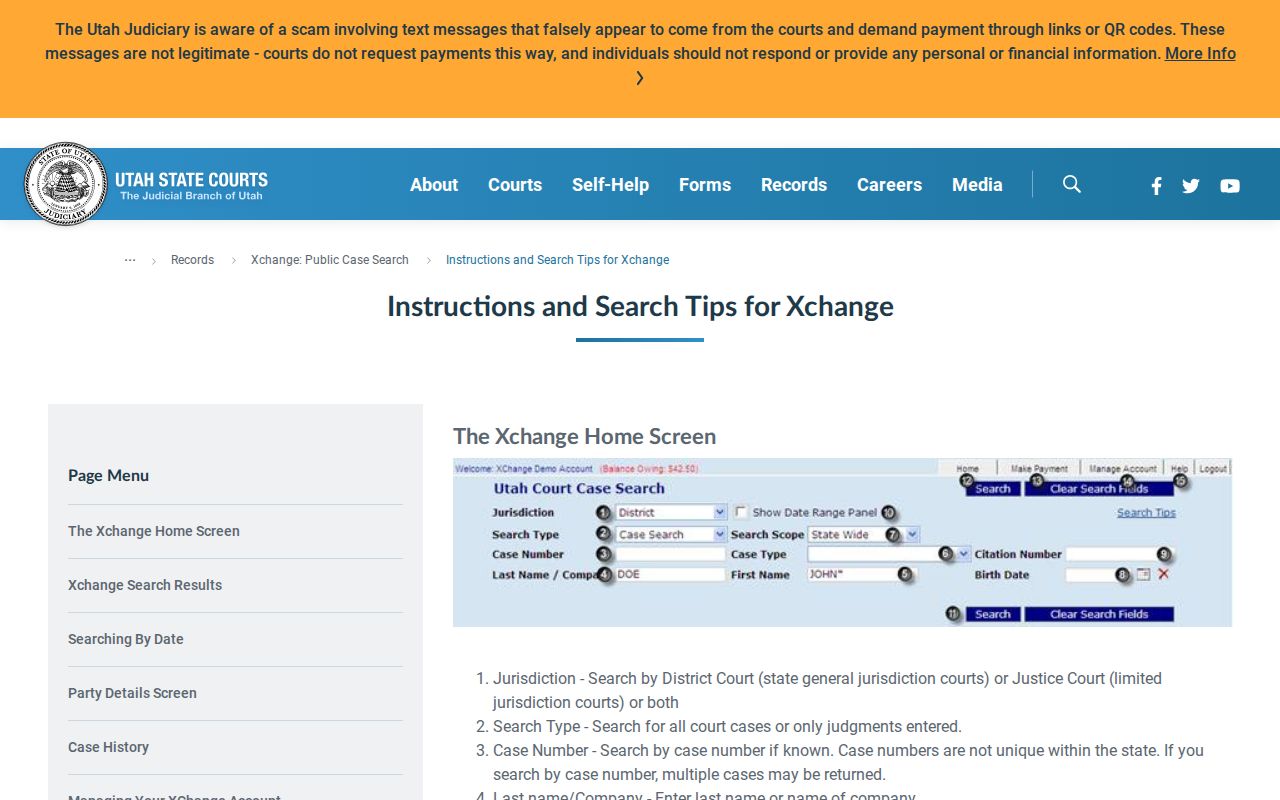
A case number and its parties are handy for cross-checking a Recorder notice. They cannot replace the recorded instrument itself.
Property Watch for Kane Owners
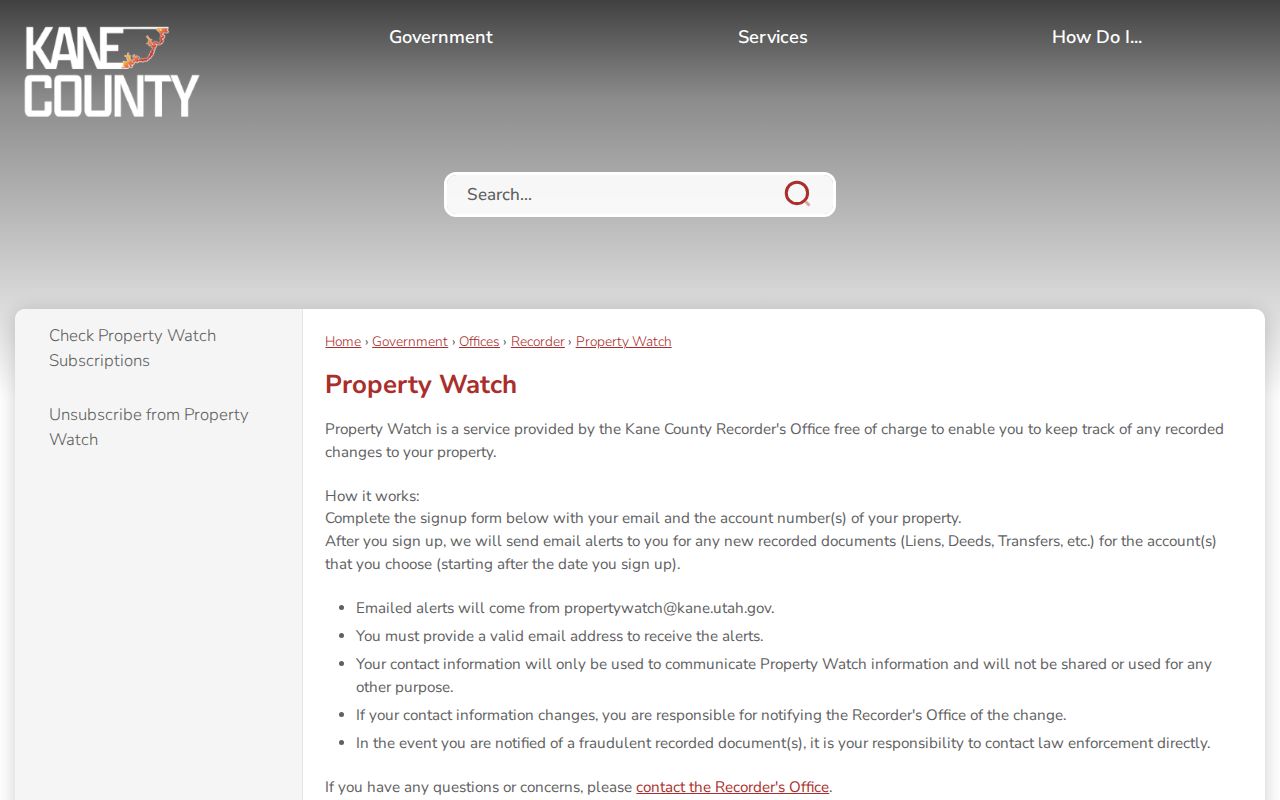
Kane County offers a free Property Watch service for property owners. Signup takes an account number and email address. The service then sends notices about new deeds, liens, and transfers recorded against the property. An alert can surface an unexpected filing early. That gives an owner time to act. Alerts do not judge validity, though. They are a cue to confirm the instrument through the Recorder.
If an alert looks suspicious, save its date and reference number. Compare it against the official index. Follow the County's instruction to contact law enforcement directly when fraud is suspected. The County's own signup guidance spells out the account-number requirement. It also notes that alerts begin only after enrollment. Kane County's Property Watch page describes free signup and fraud alerts.
Need a copy or a correction? Contact the record custodian directly. No alert service replaces a proper title review.